Is Santa real? The true story, for grown-ups

Santa Claus is not a living person, but he grew from a real one: Nicholas, a bishop in Myra, in what is now Turkey, who died around AD 343 and was known for giving gifts in secret. The Santa with a sleigh, reindeer and a North Pole workshop came later, from American stories and drawings of the 1800s.

Grown-ups first. This page answers the question plainly. If a child is reading over your shoulder, the section on what to say when kids ask is further down.

Was Santa Claus a real person?

Yes, in the sense that he started as one. Nicholas was born in Patara and became bishop of Myra, a town on the south coast of what is now Turkey. Tradition gives his life as AD 270 to December 6, 343. Almost nothing about him was written down while he lived; the first full story of his life dates from the 800s.

The best-known story is about three sisters whose father could not pay their dowries. Nicholas tossed a bag of gold through their window on three nights, and the gold landed in stockings drying by the fire. That is why stockings, shoes and gold coins still turn up at Christmas. December 6 is still his feast day; read more on our St. Nicholas Day page.

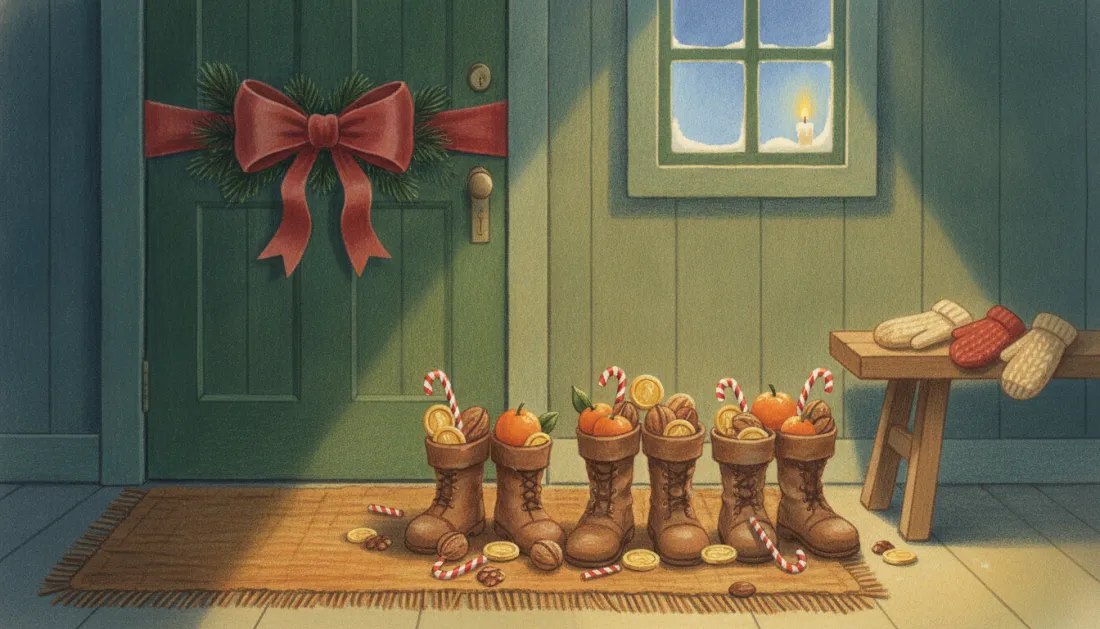
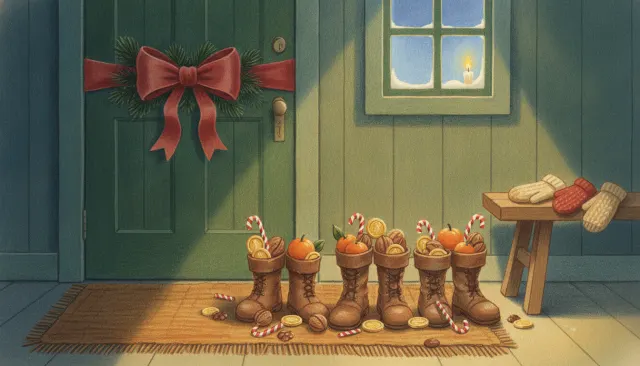
Five brown boots on a mat by a green door with a red bow, each filled with oranges, nuts, candy canes and gold chocolate coins
On December 5, children in much of Europe still set out a shoe for St. Nicholas.

How did St. Nicholas become Santa Claus?

His name came to America through Sinterklaas, the Dutch name for Nicholas. New York writers and artists then built the Santa most families know today, one piece at a time:

  • 1821A New York children's booklet shows "Santeclaus" in a sleigh pulled by one reindeer.
  • 1823"A Visit from St. Nicholas" appears in the Troy Sentinel on December 23, with eight reindeer and a trip down the chimney. You can read the whole poem here.
  • 1863Cartoonist Thomas Nast draws his first Santa for Harper's Weekly. In 1866 he labels Santa's home "Santa Claussville, N.P.", the start of the North Pole story.
  • 1900sThe red suit with white fur is already on magazine covers. Coca-Cola's famous Santa paintings, from 1931, made that look familiar but did not invent it.

Rudolph joined in 1939. Our page on Santa's reindeer has all nine names in order.

How old is Santa?

About 1,756 in 2026, if you count from AD 270, the traditional birth year of St. Nicholas. Some sources, including Turkey's Ministry of Culture, put his birth closer to 300, so "about 1,750" is the fair answer. The modern Santa Claus is younger: his sleigh, reindeer and chimney trips are about 200 years old.

What is the "Yes, Virginia" letter?

In 1897, an 8-year-old named Virginia O'Hanlon wrote to The Sun, a New York newspaper, to ask if Santa was real. The editor Francis Pharcellus Church answered in an unsigned column on September 21, 1897, under the line "Yes, Virginia, there is a Santa Claus." His answer was that Santa lives wherever there is love, generosity and wonder. It is still the most reprinted newspaper editorial in English, and many parents borrow its idea when the question comes.

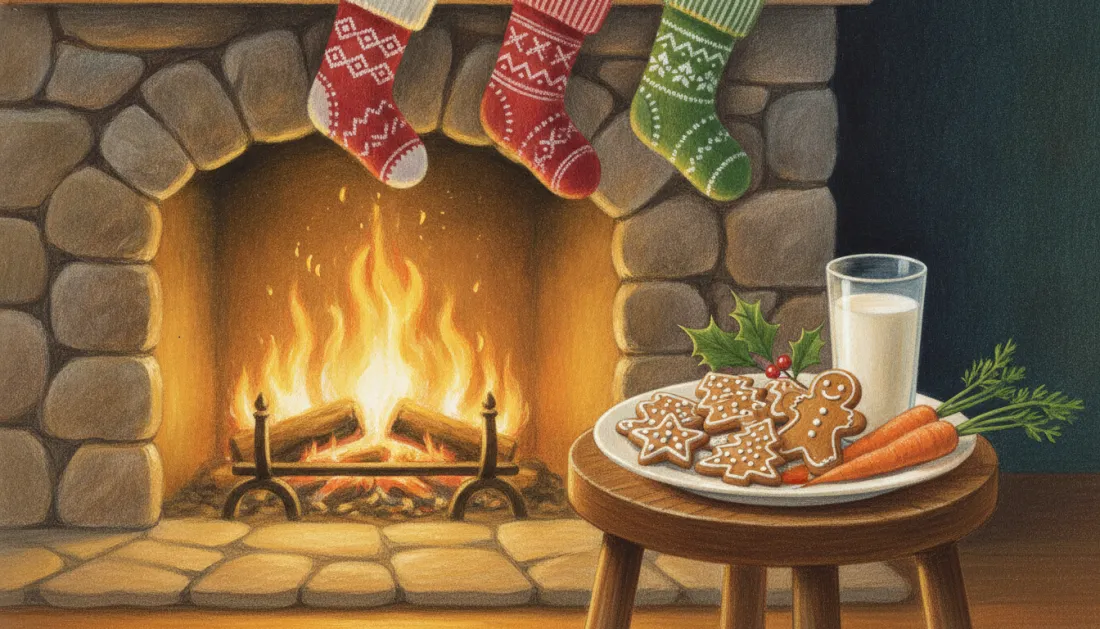
A plate of iced star and gingerbread-man cookies with a sprig of holly, a tall glass of milk and two carrots on a wooden stool beside a crackling stone fireplace, with three knitted stockings hanging above
Cookies by the fire: a ritual that works whatever a family believes.

At what age do kids stop believing in Santa?

Doubt usually starts between 7 and 9, according to McGill University's Office for Science and Society. It often begins with small puzzles: how the sleigh fits every roof in one night, why Santa's handwriting looks like Mom's, why the mall Santa and the parade Santa look different.

Finding out does not have to spoil anything. In a University of Exeter survey of about 1,200 people, most of them adults looking back, 34 percent said believing made them behave better and 47 percent said it did not.

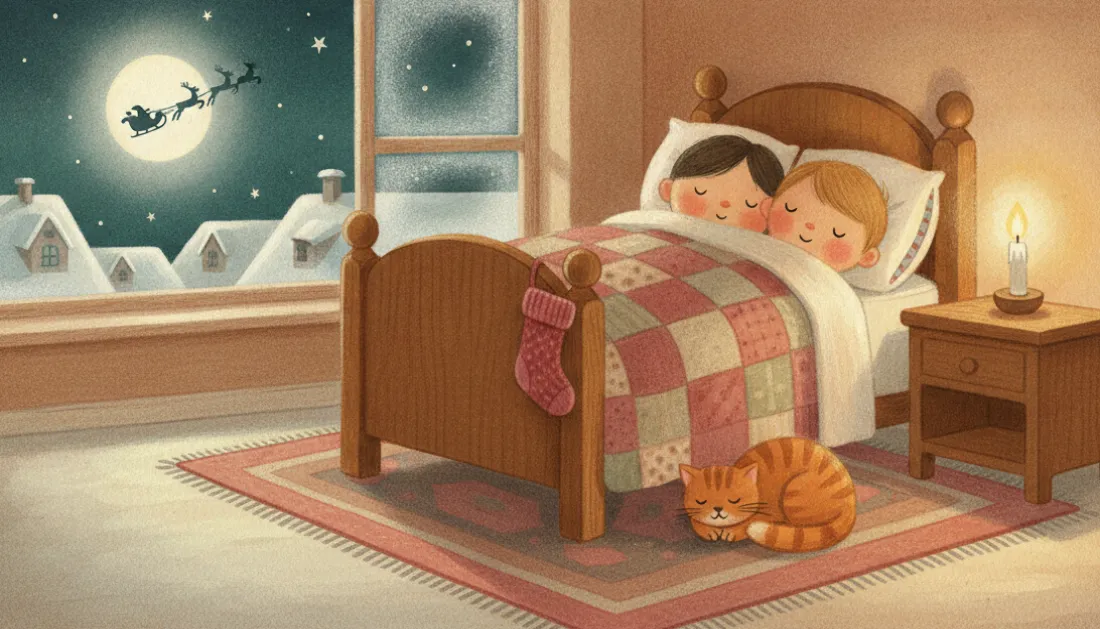
Two children asleep under a patchwork quilt in a wooden bed, a red stocking hanging from the bedpost and an orange cat curled on the rug, while through the frosty window a sleigh and reindeer fly across the full moon over snowy rooftops
Most children start to wonder between 7 and 9.

What should I say when my child asks if Santa is real?

There is no single right script, and you know your child best. These steps help most families:

  1. Ask what they think first. "What do you think?" tells you whether they want the magic or the truth. A 5-year-old asking at bedtime and a 9-year-old asking after a school argument want different things.
  2. Answer the question they asked. "How does Santa get down the chimney?" is a story question. "Is it you?" asked twice is a request for the truth.
  3. Tell the true story when they're ready. Start with Nicholas, the bishop who gave gifts in secret. It turns "you lied" into "you're old enough to know how it works."
  4. Give them a part to play. Many families invite an older child to help be Santa: filling a younger sibling's stocking, writing a letter from Santa or making "From: Santa" gift tags.
  5. Keep the rituals. Cookies on the hearth, a stocking, a letter to Santa: the fun of them does not end when the belief does.

Is the Santa on Frugal Santa real?

No. He is an AI video character made for holiday fun, and he talks live on a video call in the browser. With children he stays in character, the way a Santa at a parade or the mall does: if a child asks whether he's real, he answers along the lines of "What do you think? The magic is in believing, and in being kind." If a grown-up sincerely asks, he says he is an AI Santa.

A grown-up starts every call. Santa won't ask for a last name, an address or a school, and he never promises that a gift will come. After the call, the wishes come back as a list with store prices, lowest first. Read more about how the AI Santa works, or call Santa yourself. $1 a minute.

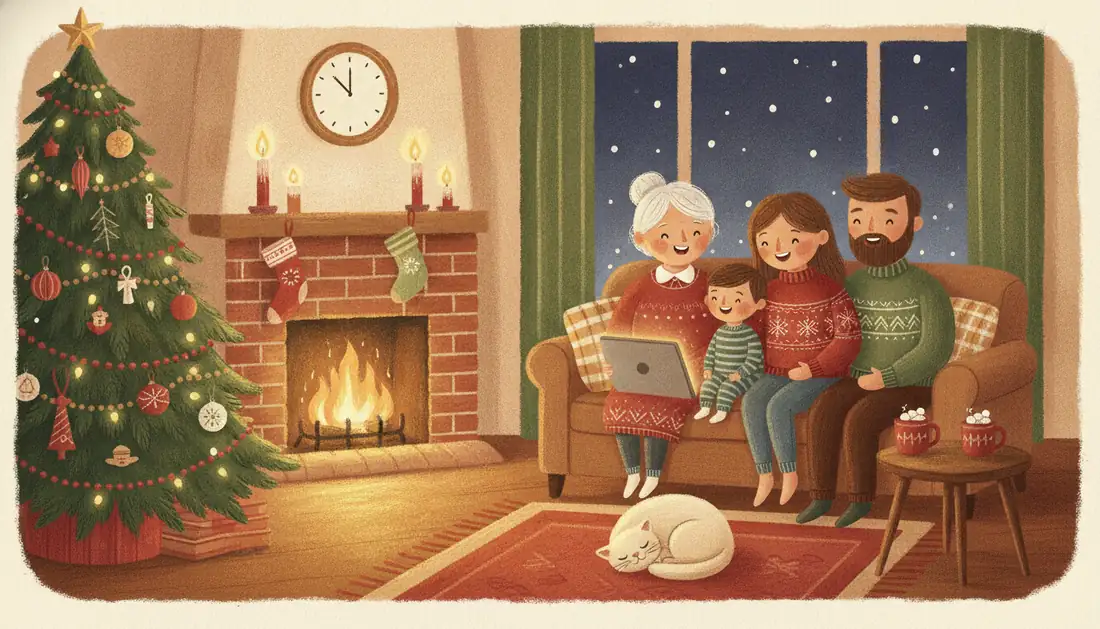
A grandmother holds a laptop on the sofa while a small boy and his parents smile at a video call beside the fireplace
Santa on Frugal Santa is an AI video character, live on a call.

Questions about Santa

Is Santa Claus a real person?

Not a living one. Santa Claus grew from a real man, Nicholas, a bishop in Myra (now Demre, Turkey) who died around AD 343 and was remembered for giving gifts in secret. The Santa with a sleigh and eight reindeer comes from American stories and drawings of the 1800s.

How old is Santa in 2026?

About 1,756, if you count from AD 270, the traditional birth year of St. Nicholas. Some sources put his birth closer to 300, so "about 1,750" is the fair answer. In the stories, Santa never seems to get any older.

At what age do kids stop believing in Santa?

Doubt usually starts somewhere between 7 and 9, according to McGill University's Office for Science and Society. Every child is different: some work it out at 5, and some still believe at 10.

Is the Santa on Frugal Santa a real person?

No. Santa on Frugal Santa is an AI video character who talks live, made for holiday fun. With children he stays in character, the way a Santa at a parade does. If a grown-up sincerely asks, he says he is an AI Santa.

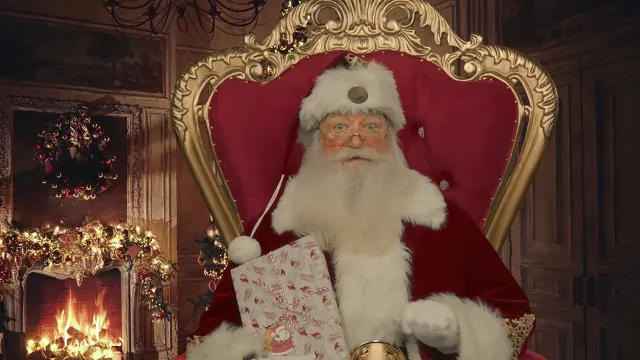
Santa in his red suit on a gold throne, holding a wrapped giftLive video

Keep the magic going.

Santa answers live video calls in your browser, for kids with a grown-up and for grown-ups too. With children he stays in character. $1 a minute.

Call Santa