St. Nicholas Day, December 6, 2026

St. Nicholas Day is December 6, the feast of Nicholas of Myra, the gift-giving bishop whose story grew into Santa Claus. In 2026 it falls on a Sunday. On the eve, Saturday, December 5, children set a shoe or boot by the door, and in the morning it holds a clementine, chocolate coins and a small gift.

St. Nicholas Day in

-- sleeps

Shoes go out on Saturday, December 5. St. Nicholas Day is Sunday, December 6, 2026.


Fill a St. Nicholas shoe

Pick who the shoe is for. The elves suggest one thing from each corner of the old custom: a fruit, a sweet, one small gift and a bit of the story.

  1. Something round and goldA clementineRound and gold, like the golden balls in some tellings of the story.
  2. Something sweetGold chocolate coinsFor the bags of gold Nicholas tossed through the window.
  3. One small giftWarm striped socksThey fit in the toe of the shoe.
  4. A bit of the storyA note from St. NicholasWrite one below, then print it or save it as a picture.

When is St. Nicholas Day 2026?

St. Nicholas Day 2026 is Sunday, December 6, and St. Nicholas Eve is Saturday, December 5. The date never moves. December 6 is the day Nicholas of Myra died, by tradition in the year 343, and churches have kept it as his feast for centuries. Most families mark it in two parts: a shoe goes out on the evening of December 5, and it is full on the morning of December 6. In the Netherlands, the big night is the eve itself, called pakjesavond, or present evening. Churches that still use the old Julian calendar keep the feast on December 19, which is their December 6. Ukraine moved its celebration to December 6 in 2023, when its main churches changed calendars. St. Nicholas Day is not a public holiday in the United States, so a Sunday date in 2026 is handy: no school morning rush, and time to linger over the shoes.

YearShoes out (the eve)St. Nicholas Day
2026SaturdaySat, Dec 5SundaySun, Dec 6
2027SundaySun, Dec 5MondayMon, Dec 6
2028TuesdayTue, Dec 5WednesdayWed, Dec 6
2029WednesdayWed, Dec 5ThursdayThu, Dec 6
2030ThursdayThu, Dec 5FridayFri, Dec 6
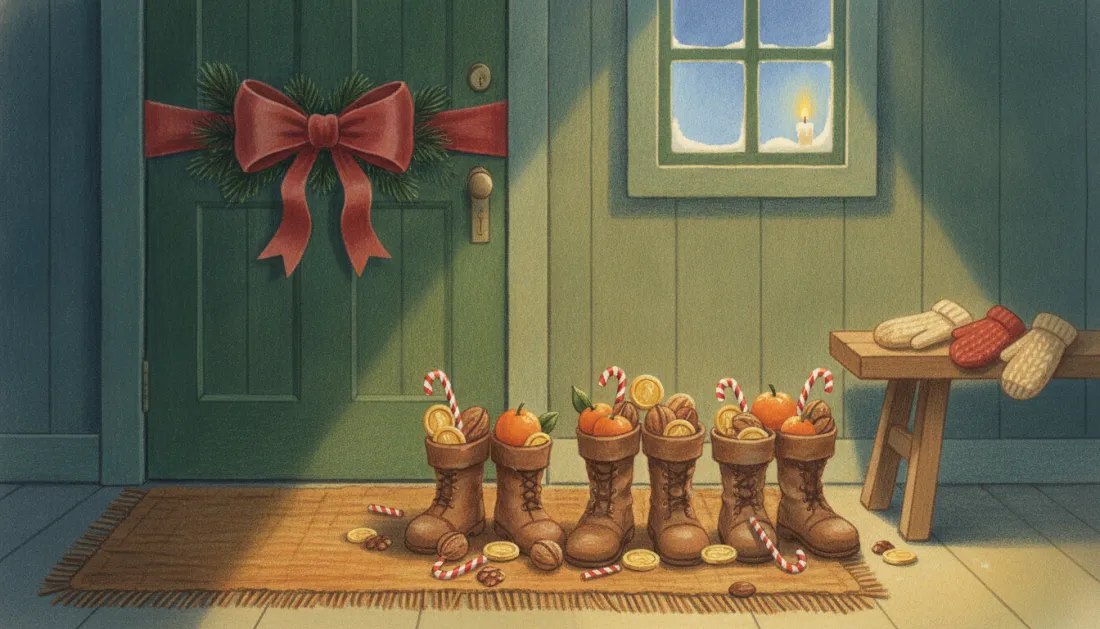
Six brown lace-up boots in a row on a doormat by a green front door with a red bow, each filled with clementines, gold chocolate coins, walnuts and candy canes, with a candle glowing in the frosty window and knitted mittens on a wooden bench
December 6, first thing: every boot by the door has been filled.

Who was St. Nicholas?

St. Nicholas was a bishop of Myra, a town in Lycia on the south coast of what is now Turkey, in the 300s. Tradition says he was born around 270 in Patara, a port nearby, to wealthy parents who died when he was young, and that he gave his inheritance away to people in need. He died on December 6, and the year usually given is 343. Very little of this can be checked. No writing by Nicholas survives, nobody in his own lifetime wrote about him, and the oldest full account of his life was written in the early 800s, about 500 years after he died. Even his seat at the great church council at Nicaea in 325 is uncertain, because his name is missing from most of the old lists of bishops who attended. What is certain is how loved he became. In 1087, sailors from Bari, Italy, carried most of his bones home, and Bari became a great place of pilgrimage.

Bari, Italybones arrive, 1087 Myratoday's Demre Patara N
From the Lycian coast to Bari: the voyage of 1087. A storybook map, not to scale.
What historians accept

On the record

  • A bishop named Nicholas probably led the church at Myra in the 300s.
  • A church named for him still stands at Myra, in the town now called Demre.
  • Sailors from Bari moved most of his bones to Italy in 1087.
  • The oldest full account of his life dates from the early 800s.
What the stories say

Handed down

  • He was born around 270 in Patara. Some accounts say nearer 300.
  • He secretly gave three bags of gold to a poor family.
  • He calmed a storm at sea, so sailors call him their patron.
  • His secret gifts made him the patron saint of children.

Why do children put out shoes on St. Nicholas Day?

Because of the oldest and best-loved Nicholas story: three bags of gold for three sisters. A poor man in Myra had three daughters and no money for their dowries, the gift a bride's family was expected to give, so none of them could marry. Nicholas heard about it. Wanting no thanks, he came by night and tossed a bag of gold through an open window. He came back for the second daughter, and again for the third. The story goes that the gold landed in stockings or shoes set by the fire to dry, and that the father caught him on the last night and was asked to keep it secret. Families tell it as the reason children in much of Europe set out a shoe on December 5, and American children hang a stocking on Christmas Eve. It is also why oranges and gold chocolate coins turn up in the toes: in some tellings, the gold came as three golden balls.

  1. The first nightA bag of gold sails through the open window.
  2. The second nightAnother bag, for the second sister.
  3. The third nightThe father catches him, and promises to keep the secret.

How do families celebrate St. Nicholas Day around the world?

Across Europe, St. Nicholas Day is a small, sweet holiday for children: a shoe on the eve and a treat in the morning. The names change from country to country, and so do the helpers who walk with him. In the Netherlands he is Sinterklaas, and the main gift evening is December 5. In Belgium he comes overnight, so children open their shoes on the morning of December 6. German and Austrian children set a boot outside the door for Nikolaus. In Czechia he walks the streets with an angel, and Polish children may find their gifts under the pillow. In the United States, the custom is strongest in cities settled by many German families, such as Milwaukee and Cincinnati. Some families keep a single evening; Dutch children often set a shoe out on several nights in the weeks before. Everywhere, the gifts stay small, because the big presents wait for Christmas.

  • Netherlands

    SinterklaasMain night: December 5

    Sinterklaas sails in by steamboat in mid-November, the story says from Spain. On evenings before the big night, children set a shoe by the fireplace with a carrot or hay for his horse and sing him a song. On December 5, pakjesavond, presents come with funny poems, and a chocolate letter of your first initial sits in the shoe.

  • Belgium

    Sinterklaas · Saint-NicolasGifts: morning of December 6

    He comes into the country through Antwerp. Children set a shoe out on the evening of December 5, with a carrot and a sugar cube for the horse, and wake to speculoos cookies, chocolate figures, chocolate coins, marzipan and tangerines.

  • Germany

    NikolausBoots out: night of December 5

    Children put a boot, the Nikolausstiefel, outside the front door. By morning it holds oranges, walnuts, chocolate and gingerbread, sometimes a chocolate St. Nicholas. In some regions a helper called Knecht Ruprecht walks with him.

  • Austria

    NikolausBoots out: night of December 5

    Children polish one boot, just one so they don't look greedy, and set it outside the door. In many towns Nikolaus walks with Krampus, a shaggy horned figure in costume, and some towns hold Krampus parades on December 5. They are loud and spooky, so watch one yourself before you take little ones.

  • Poland

    Mikołaj · MikołajkiGifts: morning of December 6

    Children clean their shoes the night before, and small gifts appear in the shoes or under the pillow overnight. Gingerbread and fruit were the old treats. Schools and offices often swap small presents on Mikołajki too.

  • Czechia

    MikulášVisits: evening of December 5

    Mikuláš walks the streets with an angel and a čert, a devil in costume. He asks children if they have been good, they sing a song or say a short poem, and the angel hands out sweets or fruit. The coal-and-potato threats are part of the joke.

  • United States

    St. Nick's DayShoes out: December 5

    The custom is strongest in cities settled by many German families, such as Milwaukee, Cincinnati, St. Louis and Evansville, Indiana. Children leave shoes or stockings out on December 5 and find oranges, chocolate coins, candy, a small toy or a new ornament in the morning.

Who is Santa Claus?

Santa Claus is the white-bearded gift-bringer of Christmas Eve, and his name and his roots go back to St. Nicholas. "Santa Claus" grew out of Sinterklaas, the Dutch name for the saint. Over time, the bishop in a red robe and tall pointed hat who filled shoes on December 6 became a round, jolly man in a fur-trimmed suit who fills stockings on the night of December 24. Most of that change happened in New York between 1809 and the 1880s, through a comic history book, a newspaper poem and a long run of magazine drawings. Along the way he traded a horse and wagon for a sleigh and eight reindeer, moved his visit to Christmas Eve and settled at the North Pole. Many countries still keep both figures: St. Nicholas on December 6, then a Christmas gift-bringer later in the month. Even the 1823 poem that made Santa famous calls its visitor St. Nick.

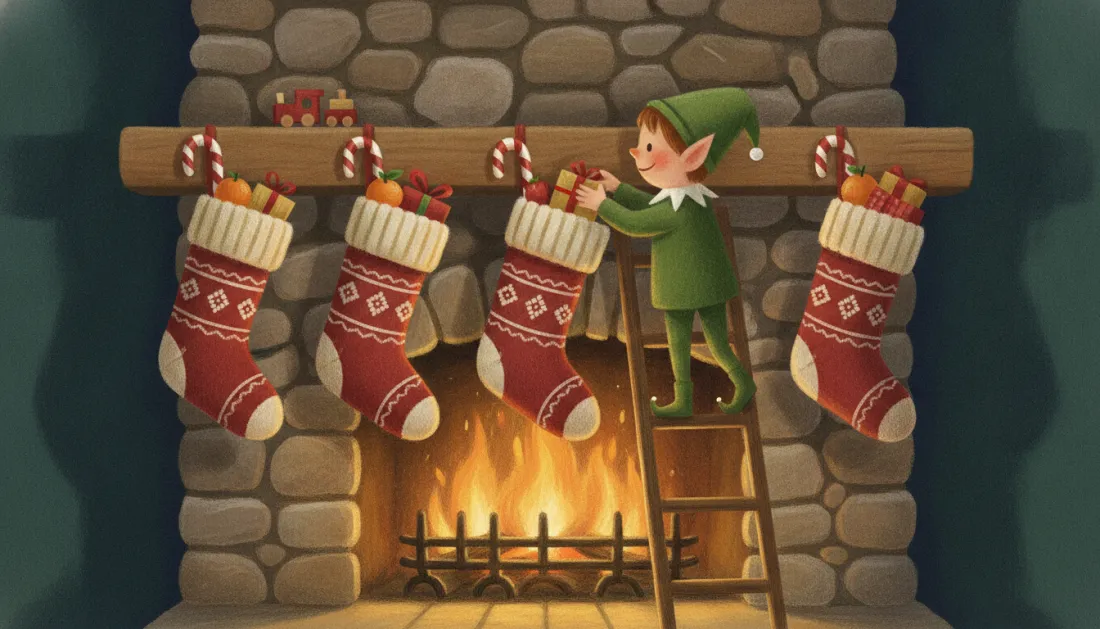
An elf on a wooden ladder tucks a small wrapped present into one of four red knit stockings hanging from a stone fireplace mantel, with oranges and gifts peeking out of the stockings, candy canes along the mantel and a toy train on top
From a shoe on December 5 to a stocking on December 24. The oranges came along.

How did St. Nicholas become Santa Claus?

Step by step, mostly in New York, over about 70 years. An old story says Dutch settlers brought Sinterklaas to New Amsterdam, but historians have found little sign that they made much of him there. The push came later, from New Yorkers who liked the idea of an old Dutch patron saint for their city. On December 6, 1809, St. Nicholas Day, Washington Irving published a comic history of New York in which St. Nicholas rides over the treetops in a wagon full of presents for children. A year later, John Pintard of the New-York Historical Society handed out a St. Nicholas picture at the society's first St. Nicholas dinner. In 1821, a small New York picture book put "Santeclaus" in a sleigh behind one reindeer. Then a poem printed in 1823 moved the visit to Christmas Eve, and Thomas Nast's drawings gave Santa the face, the belly and the North Pole home that stuck.

Today Santa has homes in many stories. See where Santa lives at the North Pole and how old he would be if you count from Nicholas.

  1. By tradition, Nicholas lives in Lycia, on the south coast of today's Turkey, and serves as bishop of Myra.

  2. Sailors from Bari, Italy, carry most of his bones home, and Bari becomes a great place of pilgrimage.

  3. On St. Nicholas Day, Washington Irving's comic A History of New York goes on sale. In it, St. Nicholas rides over the treetops in the wagon that brings children their yearly presents, and lights his pipe by the fire.

  4. John Pintard, a founder of the New-York Historical Society, hands out a St. Nicholas picture at the society's first St. Nicholas dinner. It shows two stockings by a Dutch fireside.

  5. A little New York picture book shows "Santeclaus" in a sleigh pulled by one reindeer.

  6. The Troy Sentinel prints "A Visit from St. Nicholas" with no name on it. It sets the visit on Christmas Eve, with a sleigh, eight tiny reindeer and a trip down the chimney. Clement Clarke Moore later claimed it. Read the whole poem.

  7. Thomas Nast draws his first Santa for Harper's Weekly. He will draw Santa for the magazine for more than 20 years.

  8. Nast labels Santa's home "Santa Claussville, N.P." The N.P. means North Pole.

  9. Nast's "Merry Old Santa Claus" shows the round, bearded, pipe-smoking Santa most people still picture.

  10. Santa appears in red and white on the covers of Puck magazine.

  11. Haddon Sundblom starts painting a warm, rosy-cheeked Santa for Coca-Cola's Christmas ads. They made that look famous, but they did not invent the red suit: Santa wore red long before.

What do you put in a St. Nicholas Day shoe?

Something round and gold, something sweet and one small gift, all small enough to fit in a shoe. The classics are a clementine or orange, walnuts in the shell, gold chocolate coins and a gingerbread or speculaas cookie. Each one carries a bit of the story: the coins and oranges stand for the gold, and in the Netherlands a chocolate letter with the child's first initial sits in the shoe. Add one little gift, like warm socks, a book, a tree ornament or stickers, and stop there. The shoe is the limit, and that is part of the charm. For children under 4, skip whole nuts, hard candy and popcorn, which pediatricians list as choking risks, and keep toys with small parts away from children under 3. If your family leaves out a carrot for the saint's horse, take a bite out of it before morning. Children check. The picker at the top of this page mixes a fresh shoe for each age.

Something round and gold

  • A clementine. Round and gold, like the golden balls in some tellings of the story.
  • A mandarin orange. A Dutch and Belgian shoe favorite.
  • A shiny red apple. Apples and oranges were the old St. Nicholas fruit in Poland. Age 4 and up

Something sweet

  • Gold chocolate coins. For the bags of gold Nicholas tossed through the window. Age 4 and up
  • A chocolate letter of their first initial. The Dutch shoe classic. Break it up for small hands.
  • A gingerbread heart. Gingerbread is a St. Nicholas treat in Germany and Poland.
  • Speculaas cookies. Thin spiced cookies that Dutch and Belgian children find in their shoes.
  • A chocolate St. Nicholas. Little chocolate bishops are a German December 6 gift.
  • Walnuts in the shell. An old German shoe treat. Crack them open together after breakfast. Age 4 and up
  • A candy cane. A red-and-white stripe to start the season. Age 4 and up

A bit of the story

  • A note from St. Nicholas. Write one below, then print it or save it as a picture.
  • A carrot for his horse, with one bite gone. Dutch children leave a carrot or hay out for Sinterklaas's horse. Age 4 and up
  • Three gold coins in a little cloth bag. One for each sister in the story. Age 4 and up
  • A coin to give away in secret. Nicholas gave without being seen. Pass it on today. Age 4 and up

One small gift, by age

Under 4

  • A sturdy board book
  • Soft mittens
  • A small plush lamb
  • Chunky crayons

4 to 7

  • Soft mittens
  • Warm striped socks
  • A picture book
  • A sheet of stickers
  • A new ornament for the tree
  • A yo-yo

8 to 12

  • Warm striped socks
  • A sheet of stickers
  • A new ornament for the tree
  • A yo-yo
  • A paperback chapter book
  • A pocket notebook and a gel pen
  • A deck of cards and a new game to learn
  • A small flashlight for reading in bed
  • A puzzle book

Teens and grown-ups

  • A new ornament for the tree
  • A pocket notebook and a gel pen
  • A deck of cards and a new game to learn
  • Thick wool socks
  • A really good chocolate bar
  • A packet of flower seeds for spring
  • A puzzle book

How do you start a St. Nicholas Day tradition at home?

Tell the story on the evening of December 5, set out the shoes, and keep the morning small and slow. In 2026 the eve falls on a Saturday, so there is no school night to rush. After dinner, tell the story of the three bags of gold; it takes about two minutes. Then let everyone, grown-ups too, pick one shoe or boot, brush it clean and set it by the front door or the fireplace. Younger children can tuck in a drawing for St. Nicholas or a carrot for his horse, the way Dutch children do. Once they are asleep, fill each shoe with a fruit, a sweet and one small gift, and add a short note from St. Nicholas. In the morning, open the shoes together before breakfast. Then do one kind thing in secret for someone else that day, because giving without being seen is the heart of the bags-of-gold story.

Shoe night plan, 2026

  1. Saturday, after dinnerTell the story of the three bags of gold.
  2. Before bedOne clean shoe each, set by the door.
  3. For the horseA carrot, some hay or a drawing in the shoe.
  4. Lights outFill each shoe: a fruit, a sweet, a small gift and a note.
  5. Sunday morningOpen the shoes together before breakfast.
  6. All dayOne kind thing for someone else, in secret.

Write a note from St. Nicholas

Fill in a name and one good thing from this year. The note updates as you type. Print it, or save it as a picture, then fold it into the shoe. Nothing you type leaves this device.

Dear friend,

I heard that this year you helped at home without being asked. That is just the kind of thing I like best.

Here is a little something in your shoe. Keep a bit for yourself, and share a bit with someone who needs it.

With love,

St. Nicholas

December 6, 2026
On to Christmas

St. Nicholas Day leaves 19 sleeps until Christmas, so it is a natural day to start wish lists. A call to Santa makes a fun end to the morning: talk to Santa on a live video call from a phone or computer, tell him what you are hoping for this year, and the wishes come back afterwards as a list with store prices, lowest first. Santa here is an AI video character, and kids call with a grown-up. If you want to know how it works first, read how to call Santa. When December 24 comes, the stockings take over from the shoes: here are Christmas Eve traditions to try, the "Night Before Christmas" poem to read aloud, and a Christmas countdown to keep the sleeps.

St. Nicholas Day questions

Is St. Nicholas the same as Santa Claus?

Santa Claus grew out of St. Nicholas, and his name comes from Sinterklaas, the Dutch name for the saint. In most stories they are told apart: St. Nicholas is a bishop who comes on December 6 in a red robe and tall pointed hat, and Santa Claus is the jolly gift-bringer of Christmas Eve.

Is St. Nicholas Day a holiday in the United States?

Not a public one. It is not a federal holiday, and schools and offices stay open. Families, churches and some schools keep it, especially in cities with strong German roots, such as Milwaukee and Cincinnati.

Do you put out a shoe or a stocking?

Either works. In most of Europe it is a shoe or a boot, and in German towns it is usually a boot by the front door. Many American families use their Christmas stockings early, on December 5.

Why do people get oranges on St. Nicholas Day?

In some tellings of the story, the gold Nicholas tossed through the window came as three golden balls, and oranges stand in for them. Some longtime Milwaukee families remember an orange in the toe as a big winter treat.

Who is Krampus?

In Austria and parts of nearby countries, Krampus is a shaggy, horned character from old folk tales who walks with St. Nicholas on December 5. In the stories he grumbles at children who misbehaved while Nicholas hands out treats. Today he mostly turns up in costume parades. For little ones, the shoe and the treats are the whole story.

What do Dutch children leave in their shoes?

A carrot, a bit of hay or an apple for Sinterklaas's horse, and often a drawing for Sinterklaas. They sing a Sinterklaas song before bed, and in the morning they find candy or a small present in the shoe.

Santa in his red suit on a gold throne, holding a wrapped giftLive video

After the shoes, tell Santa your wishes.

A live video call with Santa for kids and grown-ups. Tell him your wishes, then see each one priced across stores, lowest first. $1 a minute.

Call Santa