’Twas the Night Before Christmas: the full poem

“The Night Before Christmas” is the 1823 poem “A Visit from St. Nicholas,” credited to Clement Clarke Moore. All 56 lines are below in 14 short stanzas. Tap Read aloud for big type and one stanza per screen, or print a clean copy to read on Christmas Eve.

The full poem, 56 lines

A Visit from St. Nicholas

Credited to Clement Clarke Moore. First printed with no name in the Troy Sentinel, Troy, New York, on December 23, 1823. This is the text of Moore’s own book, Poems (1844), with four old spellings made modern.

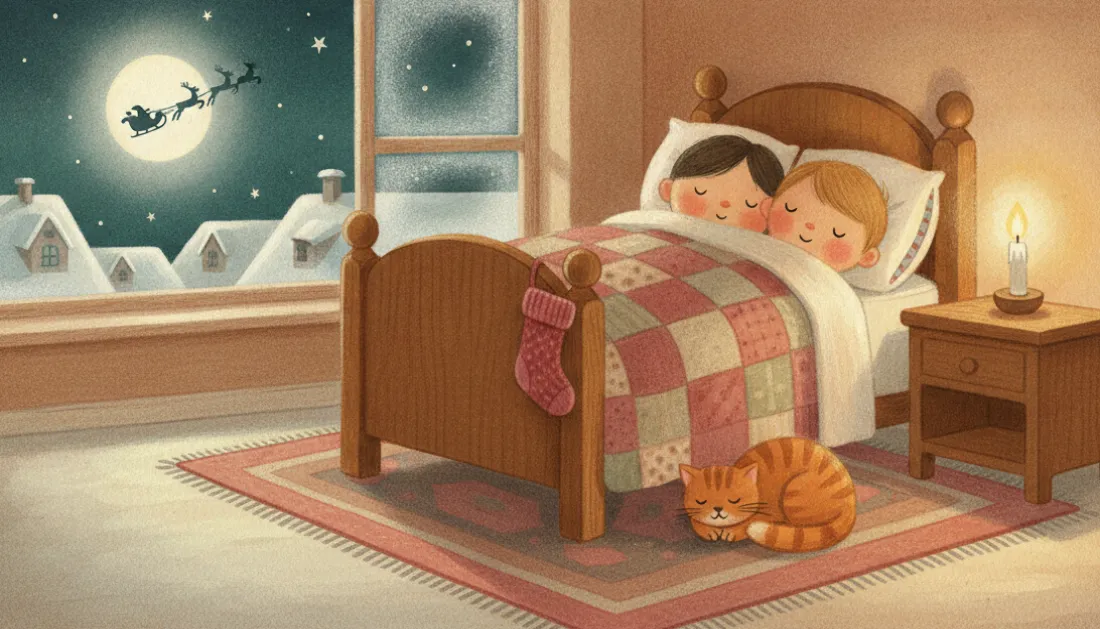
Two children asleep under a patchwork quilt in a wooden bed, a red stocking hanging from the bedpost and an orange cat curled on the rug, while through the frosty window a sleigh and reindeer fly across the full moon over snowy rooftops
The children were nestled all snug in their beds.
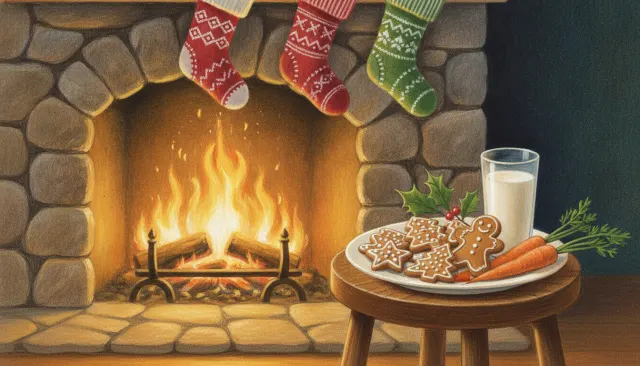
  1. ’Twas the night before Christmas, when all through the houseNot a creature was stirring, not even a mouse;The stockings were hung by the chimney with care,In hopes that St. Nicholas soon would be there;

  2. The children were nestled all snug in their beds,While visions of sugar-plums danced in their heads;And Mamma in her ’kerchief, and I in my cap,Had just settled our brains for a long winter’s nap;

  3. When out on the lawn there arose such a clatter,I sprang from the bed to see what was the matter.Away to the window I flew like a flash,Tore open the shutters and threw up the sash.

  4. The moon on the breast of the new-fallen snow,Gave the lustre of mid-day to objects below.When, what to my wondering eyes should appear,But a miniature sleigh, and eight tiny reindeer,

  5. With a little old driver, so lively and quick,I knew in a moment it must be St. Nick.More rapid than eagles his coursers they came,And he whistled, and shouted, and called them by name;

  6. “Now, Dasher! now, Dancer! now, Prancer and Vixen!On, Comet! on, Cupid! on, Donder and Blitzen!To the top of the porch! to the top of the wall!Now dash away! dash away! dash away all!”

  7. As dry leaves that before the wild hurricane fly,When they meet with an obstacle, mount to the sky;So up to the house-top the coursers they flew,With the sleigh full of Toys, and St. Nicholas too.

  8. And then, in a twinkling, I heard on the roof,The prancing and pawing of each little hoof—As I drew in my head, and was turning around,Down the chimney St. Nicholas came with a bound.

  9. He was dressed all in fur, from his head to his foot,And his clothes were all tarnished with ashes and soot;A bundle of Toys he had flung on his back,And he looked like a pedlar just opening his pack.

  10. His eyes—how they twinkled! his dimples how merry!His cheeks were like roses, his nose like a cherry!His droll little mouth was drawn up like a bow,And the beard of his chin was as white as the snow;

  11. The stump of a pipe he held tight in his teeth,And the smoke it encircled his head like a wreath;He had a broad face and a little round belly,That shook when he laughed, like a bowlful of jelly.

  12. He was chubby and plump, a right jolly old elf,And I laughed when I saw him, in spite of myself,A wink of his eye and a twist of his head,Soon gave me to know I had nothing to dread;

  13. He spoke not a word, but went straight to his work,And filled all the stockings; then turned with a jerk,And laying his finger aside of his nose,And giving a nod, up the chimney he rose;

  14. He sprang to his sleigh, to his team gave a whistle,And away they all flew like the down of a thistle.But I heard him exclaim, ere he drove out of sight,“Happy Christmas to all, and to all a good night.”

56 lines, 14 stanzas, 540 words. At an easy bedtime pace of about 130 words a minute, that is about 4 minutes.

“A Visit from St. Nicholas,” credited to Clement Clarke Moore, text of his Poems (1844). Printed from frugalsanta.lol/night-before-christmas/

’Twas the Night Before Christmas

Stanza 1 of 14

Tap the right side for the next stanza and the left side to go back, or use the arrow keys. “The end” closes it.

Who wrote ’Twas the Night Before Christmas?

Clement Clarke Moore is credited with the poem, and his name has been printed on it since 1837, but the question was never fully settled. Moore (1779 to 1863) was a Bible scholar who taught at the General Theological Seminary in New York City. His family’s story says he wrote the verses for his own children and read them aloud on Christmas Eve 1822. A friend copied them, and the Troy Sentinel printed them with no name on December 23, 1823. In 1844 Moore put the poem in his own book, Poems, and said he wrote it “not for publication, but to amuse my children.” The other candidate is Major Henry Livingston Jr. (1748 to 1828), a farmer and poet from Poughkeepsie, New York. Long after his death, his children said he had read them the same poem as his own years before it was printed. Scholars still argue both sides.

The case for Moore

  • His name went on the poem in The New-York Book of Poetry in 1837, and he claimed it in print in 1844. Nobody challenged him in public while he was alive.
  • The poem reached the Sentinel through two women in Troy, Harriet Butler and Sarah Sackett, and Butler was a friend of Moore’s family.
  • Copies of the poem in Moore’s own handwriting survive. The New-York Historical Society has one.
  • Livingston never said he wrote it, and no printing with his name on it has been found.

The case for Livingston

  • Two of his sons and a neighbor remembered him reading the poem to them as his own around 1807, sixteen years before it was printed.
  • He wrote many cheerful poems in the same bouncing meter, while Moore’s signed poems mostly use other meters.
  • Vassar professor Don Foster made the case in his 2000 book Author Unknown, comparing word habits in both men’s writing.
  • MacDonald P. Jackson’s 2016 book ran statistical tests on the poem and also pointed to Livingston. Moore’s defenders, such as document dealer Seth Kaller, reject those findings.

This page says “credited to Clement Clarke Moore” because his name has stood on the poem since 1837 and the case against him has not been proved. Read both lists aloud after the poem and let the family vote.

When was “The Night Before Christmas” first published?

The poem first appeared on December 23, 1823, in the Troy Sentinel, a newspaper in Troy, New York. It ran with no author’s name under the title “Account of a Visit from St. Nicholas,” and the editor, Orville L. Holley, wrote a note above it saying he did not know who had sent it. Other papers and almanacs reprinted it for years, still unsigned. Moore’s name first appeared with it in 1837, and his own book, Poems, followed in 1844. That 1844 text is the one on this page. The 1823 version is nearly the same, word for word, with a few small changes: the last two reindeer were Dunder and Blixem, from the Dutch for thunder and lightning, and the narrator “sprung” from his bed and to his sleigh, where 1844 says “sprang.” Both end the same way: “Happy Christmas to all, and to all a good night.” If your picture book says “Merry Christmas,” it has changed Moore’s line.

TROY SENTINEL

For the Sentinel.

ACCOUNT OF A VISIT FROM ST. NICHOLAS.

’Twas the night before Christmas, when all thro’ the house,
Not a creature was stirring, not even a mouse;
…
“On! Comet, on! Cupid, on! Dunder and Blixem;

The 1823 spelling, as first printed, with no author’s name.

Where the 1823 and 1844 texts differ

Stanza1823, Troy Sentinel1844, Moore’s Poems
3I sprung from the bedI sprang from the bed
6On! Comet, on! Cupid, on! Dunder and Blixem;On, Comet! on, Cupid! on, Donder and Blitzen!
7As dry leaves before the wild hurricane fly,As dry leaves that before the wild hurricane fly,
9A bundle of toys was flung on his back,A bundle of Toys he had flung on his back,
13then turn’d with a jirk,then turned with a jerk,
14He sprung to his sleigh,He sprang to his sleigh,

Apart from these lines and some spelling and commas, the two match. Moore’s 1844 book prints Donder; “Donner,” the German word for thunder, became the usual spelling in the 1900s. The story of all eight names is on the Santa’s reindeer page.

What do the old words in “The Night Before Christmas” mean?

Most of the puzzling words are everyday English from the 1820s that has since gone out of use. Sugar-plums were small, hard sweets, usually a seed, nut or bit of spice coated in layers of sugar, and often with no plum in them at all. Mamma’s ’kerchief is a cloth tied over her hair for bed, and the father’s cap is a nightcap. The sash is the sliding frame of the window, so throwing up the sash means pushing the window open. Coursers are swift horses, an old word the poem borrows for the reindeer, and St. Nick is short for Saint Nicholas, the bishop whose feast day is December 6. A pedlar sold goods from a pack on his back, droll means funny in an odd way, and ere means before. The down of a thistle is the fluff that carries its seeds on the wind. Here is every one, in the order you meet it.

  • sugar-plumsvisions of sugar-plums danced in their headsStanza 2

    Small, hard sweets: a seed, nut or bit of spice coated in layer after layer of sugar. Many had no plum in them at all.

  • ’kerchiefMamma in her ’kerchiefStanza 2

    Short for kerchief, a square of cloth tied over the hair. Mamma wears hers to bed.

  • capand I in my capStanza 2

    A soft nightcap. The father telling the story is ready for bed too.

  • sashthrew up the sashStanza 3

    The frame that holds a window’s glass. Throwing it up means pushing a sliding window open.

  • lustrethe lustre of mid-dayStanza 4

    Shine. Moonlight on new snow made the yard look as bright as noon.

  • coursershis coursers they cameStanza 5

    An old word for swift horses. The poem uses it for the reindeer.

  • St. Nickit must be St. NickStanza 5

    Short for Saint Nicholas, a bishop of the 300s whose feast day is December 6. More on St. Nicholas Day.

  • Donder and Blitzenon, Donder and Blitzen!Stanza 6

    Thunder and lightning. The 1823 newspaper printed Dunder and Blixem, from the Dutch. All eight names: Santa’s reindeer.

  • in a twinklingAnd then, in a twinklingStanza 8

    In an instant, about as long as a blink.

  • pedlarlike a pedlar just opening his packStanza 9

    An old spelling of peddler: someone who went door to door selling goods from a pack.

  • drollHis droll little mouthStanza 10

    Funny in an odd, quaint way.

  • right jollya right jolly old elfStanza 12

    Right means very here, so he is a very jolly little elf.

  • finger aside of his noselaying his finger aside of his noseStanza 13

    A knowing sign, like a wink. Washington Irving’s St. Nicholas makes it too, and Irving calls it “the significant sign of St. Nicholas.”

  • ereere he drove out of sightStanza 14

    Before.

  • down of a thistlelike the down of a thistleStanza 14

    Thistledown, the soft fluff that carries thistle seeds away on the wind.

How did “The Night Before Christmas” shape Santa Claus?

It took ideas that were already drifting around New York and fixed them into one picture that stuck. Washington Irving’s comic History of New York had St. Nicholas smoking a pipe, riding over the treetops and dropping gifts down chimneys, and an 1821 picture book gave him a reindeer, a sleigh and a Christmas Eve visit. The 1823 poem put it all into one night: a sleeping house on Christmas Eve, eight reindeer with names, the first time any were named, a landing on the roof, a trip down the chimney and stockings filled before morning. It also gave him the face people still picture, with twinkling eyes, rosy cheeks, a cherry nose, a snow-white beard and a round belly that shakes when he laughs. One thing the poem never mentions is red. Moore’s St. Nick is dressed all in fur, and he is small: a jolly old elf with a miniature sleigh.

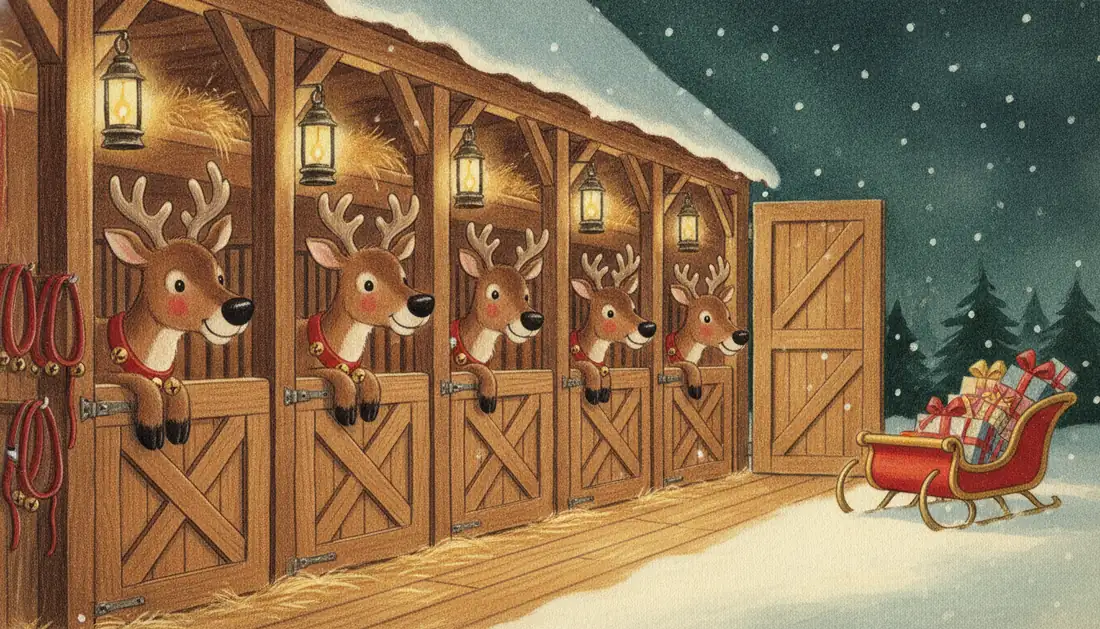
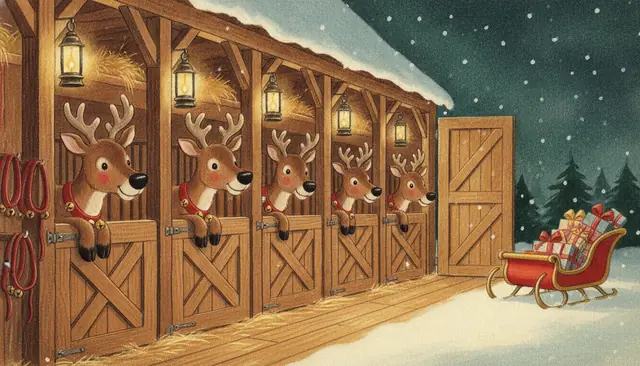
Five smiling reindeer with red collars and gold bells lean over the half doors of a snowy wooden stable lit by lanterns, while a red sleigh piled with wrapped presents waits outside in the falling snow
Eight tiny reindeer, named for the first time in 1823.
  1. 1809

    Washington Irving’s comic History of New York (1809, revised in later editions) has St. Nicholas ride over the treetops in a wagon, smoke a pipe, drop presents down chimneys and lay “his finger beside his nose.”

  2. 1821

    A New York picture book, Old Santeclaus with Much Delight, gives him a sleigh, a single reindeer and a Christmas Eve visit.

  3. 1823

    The poem puts it all in one night and names eight reindeer for the first time. He is a tiny, round, jolly elf, dressed all in fur, with a miniature sleigh.

  4. 1863

    Thomas Nast draws his first Santa for Harper’s Weekly (January 3, 1863), guided by Moore’s description: the reindeer, the sleigh, the sack of toys. He keeps drawing Santa for the magazine until 1886.

  5. 1931

    Haddon Sundblom paints Santa for Coca-Cola ads in The Saturday Evening Post. The company says he turned to Moore’s poem for a warm, plump Santa who looks like a real man.

How do you read “The Night Before Christmas” on Christmas Eve?

Read it slowly, as the last thing before bed on December 24, and let the rhythm carry you. Every line has four beats in the same bouncing pattern, ta-ta-DUM four times over, which poets call anapestic tetrameter, so once you find the bounce the poem almost reads itself. At an easy bedtime pace, all 56 lines take about 4 minutes. The Moore family story says his children first heard it on Christmas Eve 1822, and a church in Manhattan has held a public reading of it since 1911. In 2026, Christmas Eve falls on Thursday, December 24. Share it out: type names into Take turns at the top of this page, and read-aloud mode shows whose stanza is next. A grandparent can start, an older child can take the reindeer, and the youngest can say the last line. Let small children shout the eight names with you, then pause before the very last line.

  • Practice stanza 6 once. “Now, Dasher! now, Dancer!” is the tongue-twister of the poem, and it is more fun fast.
  • Before stanza 10, ask everyone to describe Santa without peeking. Then read stanzas 10 and 11 and see who was closest.
  • Keep the old words and explain them afterwards. A strange word like coursers is a treat once you know it means fast horses.
  • Print the large-print copy for anyone who reads better with big type, and the one-page copy to tuck inside a Christmas book.
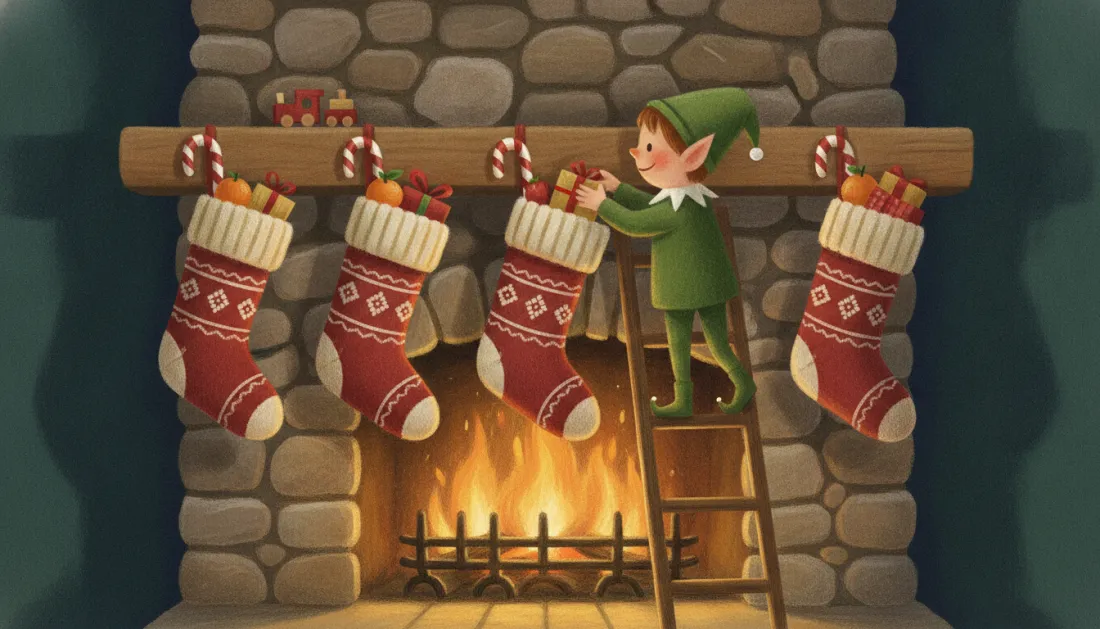
An elf on a wooden ladder tucks a small wrapped present into one of four red knit stockings hanging from a mantel over a crackling stone fireplace, with candy canes hooked along the mantel and a toy train on top
The stockings were hung by the chimney with care.

Questions often come after the last line. How do eight tiny reindeer fly? Which one is fastest? Save them for Santa. On a live video call with Santa, kids with a grown-up beside them, and grown-ups on their own, can ask about his reindeer and tell him the gift they are wishing for. Afterwards each wish comes back as a list with store prices, lowest first. Here is how calling Santa works. For more ways to fill the night, see our Christmas Eve traditions, and count the sleeps with the Christmas countdown. More stories from Santa’s home are on the North Pole page.

A reading at Moore’s grave

In Manhattan, the Church of the Intercession at Broadway and 155th Street has held a reading of the poem since 1911. In 2025 it was on Sunday, December 14, followed by a lantern procession across Broadway to Moore’s grave in Trinity Church’s uptown cemetery. Trinity Church Wall Street lists each year’s date on its events page.

Night Before Christmas questions

How long is “The Night Before Christmas”?

56 lines, printed here as 14 stanzas of four lines, 540 words in all. At an easy bedtime pace it takes about 4 minutes to read aloud.

Is the poem in the public domain?

Yes. It was first printed in 1823 and Moore died in 1863, so the words are free for anyone to read aloud, print, copy and share.

Who is telling the story?

The father of the house. He is the “I” in “Mamma in her ’kerchief, and I in my cap,” woken by a clatter on the lawn.

What is the poem’s real title?

It was first printed as “Account of a Visit from St. Nicholas.” Moore’s 1844 book calls it “A Visit from St. Nicholas.” Most people know it by its first line.

Is it Donder or Donner?

Moore’s 1844 text says Donder, and the 1823 newspaper said Dunder. Donner, the German word for thunder, became the usual spelling in the 1900s. The reindeer page has the whole story.

Why does Santa have a pipe in the poem?

Both the 1823 and 1844 texts give him “the stump of a pipe,” and Washington Irving’s St. Nicholas smoked one too. A 2012 edition from Canadian publisher Pamela McColl left those two lines out. This page keeps the poem as Moore printed it.

Santa in his red suit on a gold throne, holding a wrapped giftLive video

Tell Santa yourself.

A live video call with Santa for kids and grown-ups. Tell him your wishes, then see each one priced across stores, lowest first. $1 a minute.

Call Santa